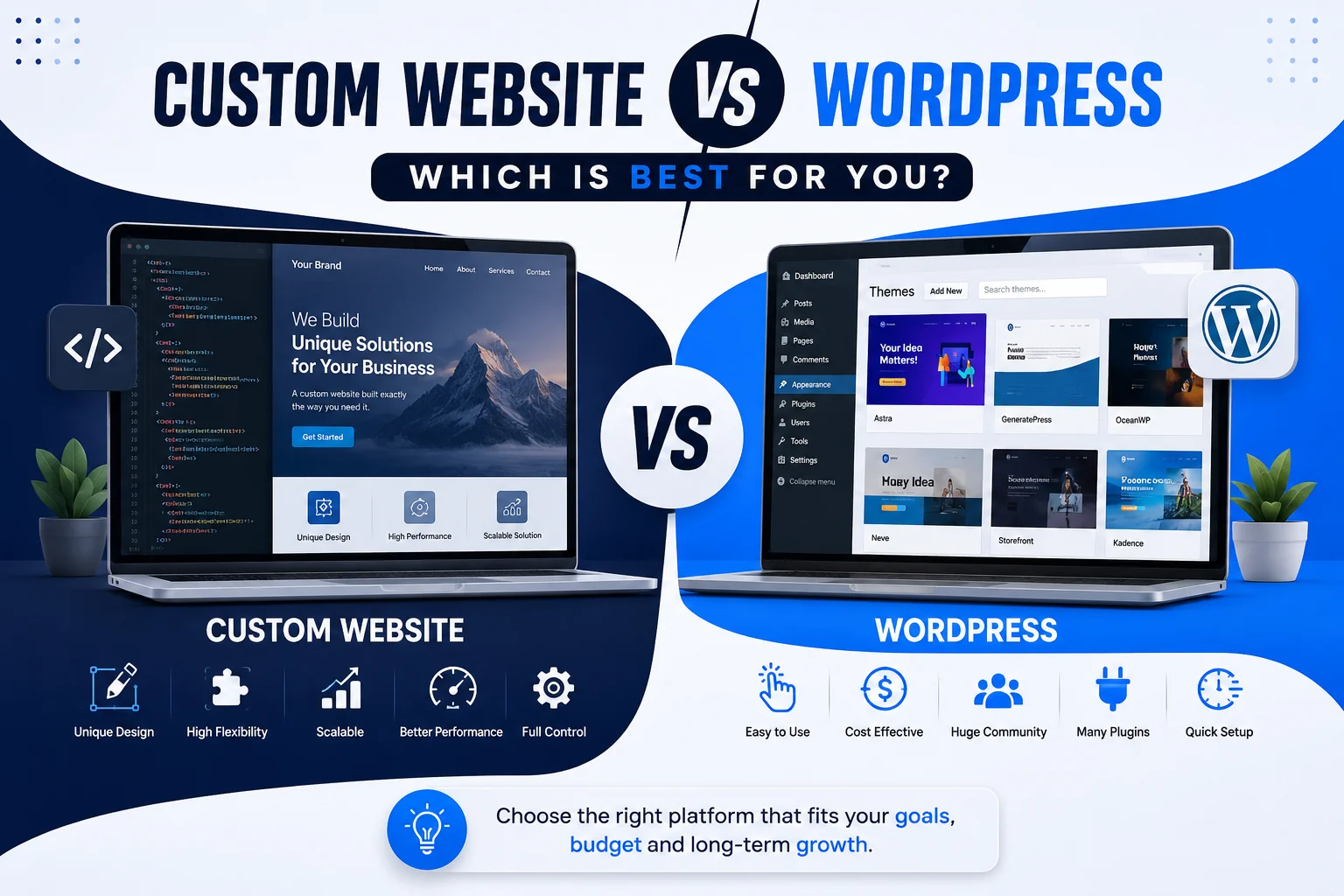
Choosing between a custom website and WordPress is not really a question of which technology is "better". The better choice depends on what your business needs today, how you expect it to grow, who will manage the website, and how much control you need over its functionality.
WordPress is often the practical choice for small businesses, service companies, bloggers and organisations that need a manageable website with established features. A custom website can make more sense when a business needs unique functionality, complex integrations, highly specific user journeys or greater control over how the website is built.
Both can produce professional, fast and search-friendly websites when they are planned and developed properly by an experienced web development agency. WordPress itself is highly extensible through themes, plugins and its developer APIs, while custom development gives a development team more direct control over the website's code and functionality.
So, should your business choose WordPress or custom web development? Let's look at the differences that actually matter.
What Is the Difference Between a Custom Website and a WordPress Website?
The biggest difference is how the website is built and managed.
A WordPress website uses WordPress as its content management system (CMS). You can choose a theme, add functionality through plugins, customise the design and manage content through the WordPress dashboard. WordPress supports everything from straightforward business websites and blogs to more complex websites and applications.
A custom website is developed specifically around the requirements of a business. Instead of starting with an existing WordPress installation and extending it, developers can build the site's front end, functionality, database structure and integrations around the project's needs.
That doesn't automatically make custom development better. It simply gives you a different level of control.
For example, a five-page consultancy website with a contact form may not need an expensive bespoke system. A business that needs a customer portal, unusual booking system, multiple third-party integrations or a highly specific workflow may benefit considerably from custom website development.
The right question is therefore not "Which technology is superior?" It is: "Which approach solves our business requirements without creating unnecessary cost or complexity?"
What Is a Custom Website and How Does It Work?
A custom website is developed around a defined set of business, design and technical requirements. Instead of selecting a ready-made theme and adapting it, the development team can decide how the website should work from the ground up.
How Is a Custom Website Built From Scratch?
A custom project normally starts with planning rather than coding. The process may include:
- Understanding the business and its customers
- Defining website goals
- Planning the site's structure
- Creating the user experience
- Designing the interface
- Developing the front end
- Building required back-end functionality
- Connecting external systems or APIs
- Testing performance and usability
- Launching and maintaining the website
The technology used depends on the project. A simple custom site and a complex web application may have completely different technical architectures.
What Can You Customise With a Bespoke Website?
With custom development, functionality can be designed around the way your business actually operates. For example, a business might need:
- A bespoke quotation system
- Customer accounts
- Advanced booking functionality
- A membership area
- Custom dashboards
- Internal business tools
- API integrations
- Bespoke calculators
- Complex product configurations
- Automated workflows
Rather than changing your business process to fit a standard plugin, developers can build the website around the process.
Who Is a Custom Website Best Suited For?
Custom development can be particularly useful for:
- Growing businesses with unusual requirements
- Companies needing complex integrations
- Businesses developing online platforms
- Organisations with specialised workflows
- Ecommerce businesses with unique requirements
- Companies that need extensive control over functionality
It can also be appropriate for a smaller business if there is a genuine technical reason for going custom. Size alone shouldn't determine the decision.
What Is a WordPress Website and How Does It Work?
WordPress is an open-source CMS that allows businesses to create and manage website content without needing to edit code every time they publish a page or article. Its flexibility comes partly from its ecosystem of themes, plugins and developer tools. WordPress provides thousands of plugins for extending functionality, while its theme system allows businesses to change the site's presentation.
Why Do Businesses Choose WordPress?
The biggest attraction is practicality. A business can launch a professional website without developing every feature from scratch. Common requirements such as contact forms, blogs, ecommerce functionality, analytics and SEO tools can be added using existing solutions. This can reduce development time and make the website easier for non-technical teams to manage.
How Easy Is It to Manage a WordPress Website?
For many businesses, this is one of WordPress's strongest advantages. Once the website has been configured properly, staff can generally add and edit pages, publish blog posts, upload images and manage other content through the dashboard. That can be particularly useful if your marketing team publishes content regularly.
Who Is WordPress Best Suited For?
WordPress can work well for:
- Small and medium-sized businesses
- Professional service companies
- Local businesses
- Consultants
- Bloggers and publishers
- Portfolio websites
- Content-focused organisations
- Businesses with standard ecommerce requirements
It is not limited to small websites either. WordPress's official documentation describes it as being used for everything from simple websites and blogs to complex portals and applications.
Is a Custom Website Better Than WordPress for Your Business?
Not necessarily. A custom website is better when your requirements justify custom development. WordPress is better when its existing ecosystem can solve your requirements efficiently.
Consider a local accounting firm that needs:
- About page
- Services pages
- Team page
- Blog
- Contact form
- Location information
Building a completely bespoke platform for this type of website may add complexity without delivering much additional business value.
Now consider a company that needs a customer portal where users log in, submit information, receive personalised quotations and connect with several internal systems. That's a different situation.
When Is a Custom Website the Better Choice?
Custom development becomes more attractive when:
- Your functionality is highly specific
- Existing plugins don't adequately solve the problem
- You require complex integrations
- Your website needs a specialised user journey
- You need complete control over the technical architecture
- Your website is becoming part of your core business operations
When Is WordPress the Better Choice?
WordPress is often sensible when:
- You need a business website relatively quickly
- Your requirements are fairly standard
- Your team wants to manage content themselves
- You publish content regularly
- You want access to an established plugin ecosystem
- You don't need extensive bespoke functionality
Does Your Business Really Need a Custom Website?
This is worth asking before spending money on development. If a reliable WordPress setup can meet your requirements without compromising your goals, there may be little reason to build everything from scratch. Custom development should solve a real business requirement — not simply make the project sound more advanced.
Is a Custom Website More Expensive Than WordPress?
Usually, custom development requires a larger initial development investment, but the total cost depends on the project. There is no reliable single price for either option.
A WordPress website can range from a relatively simple setup to a highly customised build with bespoke themes, plugins and integrations. Likewise, a custom website can range from a straightforward bespoke business site to a complex web application.
Current UK agency pricing guides show how widely costs can vary depending on design complexity, integrations, content requirements and ongoing support — see our full breakdown in How Much Does Website Development Cost in the UK? A Complete 2026 Guide.
How Much Does a WordPress Website Cost in the UK?
The cost can depend on:
- Number of pages
- Design requirements
- Theme customisation
- Premium plugins
- Ecommerce functionality
- Content migration
- Hosting
- Security
- Maintenance
- Ongoing development
A basic WordPress site and a fully customised WordPress build should not be treated as the same type of project.
How Much Does a Custom Website Cost in the UK?
Custom development usually involves more planning and development time because functionality is created specifically for the project. The cost can increase when you require:
- Bespoke functionality
- Complex databases
- User accounts
- Third-party integrations
- Advanced ecommerce
- Custom dashboards
- Automated processes
- Extensive testing
Instead of choosing an option purely because it has a lower starting price, look at the total cost of ownership and the value the website is expected to generate. For a project-specific estimate, see our web development pricing.
Which Option Offers Better Long-Term Value?
The cheaper website isn't necessarily the better investment. A £3,000 website that doesn't support your business requirements could become more expensive if you need to rebuild it a year later. Likewise, spending heavily on custom development for a simple business website may be unnecessary.
The better investment is the solution that provides the functionality you actually need without paying for complexity you don't.
Is a Custom Website Faster Than WordPress?
It can be, but custom development does not automatically mean a faster website. A well-built custom website can be developed with a very controlled codebase and only the functionality the project requires. A poorly developed custom website can still be slow. The same principle applies to WordPress.
Why Can Custom Websites Load Faster?
Developers can control:
- What code is loaded
- How assets are delivered
- How pages are structured
- Which functionality is included
- How data is requested
- How images and other resources are handled
This can make performance optimization more straightforward in some projects.
Can a WordPress Website Be Made Fast?
Yes. WordPress performance depends on factors such as hosting, theme quality, plugins, images, caching, code, database configuration and how the site is developed. The problem isn't simply that a website uses WordPress. A carefully developed WordPress website can perform very well, while an overloaded website with poorly selected plugins can create unnecessary performance issues.
Which Option Is Better for Website Performance?
Look at the implementation, not just the platform. When choosing a development agency, ask how performance will be handled rather than assuming a particular technology guarantees speed.
Which Is Better for SEO: WordPress or a Custom Website?
Both can be effective for SEO. Google's guidance focuses on creating helpful, reliable, people-first content and making websites accessible to both users and search engines. The technology behind a website is only one part of the overall picture — see why SEO is more important than ever for the bigger picture on how search visibility is evolving.
Is WordPress Good for SEO?
Yes. WordPress provides features and extensions that can support SEO, including control over content, URLs, metadata and site structure. Its extensive plugin ecosystem can also provide additional SEO functionality.
But installing an SEO plugin does not automatically make a website optimised. Technical implementation, content quality, internal linking, page experience and overall site architecture still matter. If you want a second opinion on your current setup, our affordable SEO services start with a technical review of exactly these factors.
Can a Custom Website Rank Well on Google?
Absolutely. A custom website can be built with SEO requirements considered from the beginning. Developers can plan:
- Crawlable site architecture
- Clean URLs
- Semantic HTML
- Appropriate metadata
- Internal linking
- Structured data where relevant
- Performance
- Mobile usability
- Technical SEO requirements
Which Platform Gives You More SEO Control?
Custom development can provide greater technical control, while WordPress provides a more accessible environment for managing many common SEO requirements. For most businesses, how the website is built matters more than whether the label says WordPress or custom.
Does Website Development Affect SEO Performance?
Yes. Poor development decisions can create problems such as slow pages, confusing navigation, inaccessible content or technical crawling issues. That is why SEO should not be treated as something to add after the website has been built. A strong development process considers search visibility alongside usability and performance from the beginning.
Which Is More Secure: WordPress or a Custom Website?
Neither option is automatically secure simply because of the technology used. Security depends on development quality, hosting, access controls, updates, configuration and ongoing maintenance.
Are WordPress Websites Secure for Businesses?
WordPress can be used securely by businesses, but websites need to be maintained properly. Because WordPress websites can use themes and third-party plugins, businesses need to pay attention to what they install and how those components are maintained.
What Security Risks Can WordPress Websites Have?
Potential problems can arise from:
- Outdated software
- Poorly maintained plugins
- Weak passwords
- Excessive user permissions
- Poor hosting configuration
- Unnecessary third-party components
This doesn't mean WordPress is inherently unsafe. It means maintenance is part of running a WordPress website.
Can a Custom Website Be More Secure?
A custom website can give developers tighter control over the code and functionality. However, custom code can also contain vulnerabilities if it isn't developed and maintained properly. Good security practices matter more than choosing a platform based on reputation alone.
Which Website Is Easier to Maintain: WordPress or Custom?
For content management, WordPress is usually easier for non-technical users because it provides an established administration interface. Custom websites can require developer involvement for changes, depending on how the CMS and editing system have been designed.
How Easy Is It to Update a WordPress Website?
Businesses can generally manage common content tasks themselves. That can include:
- Publishing articles
- Editing page content
- Adding images
- Managing menus
- Updating certain website elements
The exact experience depends on how the website was developed.
Does a Custom Website Require a Developer for Updates?
Not always. A custom website can include a CMS or bespoke content management interface. The key difference is that the editing experience has to be developed as part of the project rather than relying entirely on the standard WordPress environment.
What Ongoing Maintenance Does Each Option Need?
Both require maintenance. A WordPress website may need:
- Core updates
- Plugin updates
- Theme updates
- Security checks
- Backups
- Performance monitoring
A custom website may need:
- Security updates
- Framework updates
- Bug fixes
- Server maintenance
- Dependency updates
- Feature development
A website is not a "build it once and forget it" asset.
Which Is More Flexible and Scalable: WordPress or Custom Development?
Custom development generally gives you more control over specialised functionality, while WordPress provides considerable flexibility through its existing ecosystem. WordPress supports themes, plugins, custom content types and APIs, allowing developers to extend the platform significantly.
Can WordPress Scale With a Growing Business?
Yes. WordPress can support growing websites and increasingly complex requirements. The question is whether WordPress remains the most efficient solution as those requirements become more specialised.
When Does Custom Development Make More Sense?
Custom development becomes more attractive when your website needs functionality that doesn't fit comfortably into standard WordPress solutions. For example, imagine a business where the website needs to communicate with:
- CRM software
- Inventory systems
- Customer databases
- Payment platforms
- Internal business applications
At that point, the technical requirements deserve a proper architecture discussion rather than simply asking which CMS is cheapest. This is where web application development becomes a more accurate description of the project than a standard website build.
Which Option Is Better for Complex Features and Integrations?
Custom development may be preferable when the website itself is effectively a business application. For standard content publishing, WordPress may be more practical. For highly specialised workflows, bespoke development can provide greater control.
Which Option Is Better for Small Businesses in the UK?
For many UK small businesses, WordPress is a sensible starting point when the website requirements are straightforward. A local professional service business, for example, may primarily need a strong homepage, service pages, contact functionality, location information, a blog and a manageable content system. There may be little benefit in building a completely bespoke platform for those requirements.
Is WordPress a Good Choice for a UK Small Business?
It can be. The platform is flexible, widely supported and designed around publishing and managing website content.
When Should a UK Business Invest in Custom Web Development?
Consider custom development when the website needs to do something that standard solutions cannot handle efficiently. For example: a business wants customers to create accounts, submit detailed requirements, receive automated quotations and access a personalised dashboard. That isn't simply a brochure website anymore. It is a digital system, and custom development may be worth considering.
What Should UK Businesses Consider Before Choosing?
Ask yourself:
- What does the website need to do?
- Who will manage it?
- How frequently will content change?
- Do we need custom integrations?
- What is our realistic budget?
- What could the business need in three years?
- Does the website need to become part of our internal operations?
Those answers will usually point you toward the right solution.
Should You Choose WordPress or Custom Website Development?
Here's a simple way to approach the decision.
| If your priority is... | Consider... |
|---|---|
| A manageable business website | WordPress |
| Frequent content publishing | WordPress |
| Standard business functionality | WordPress |
| A large content library | WordPress |
| Easy content management | WordPress |
| Unique functionality | Custom development |
| Complex integrations | Custom development |
| Bespoke customer journeys | Custom development |
| Specialised business applications | Custom development |
| Maximum control over functionality | Custom development |
The important word here is consider. There is no universal rule saying every small business needs WordPress or every serious company needs custom development. Your website should be selected around your requirements.
What Are the Pros and Cons of WordPress and Custom Websites?
What Are the Advantages of WordPress?
WordPress offers:
- An established CMS
- Easy content management
- A large ecosystem
- Thousands of plugins
- Extensive themes and design options
- Strong publishing capabilities
- Flexibility for different types of websites
WordPress's official platform documentation highlights its themes, plugins, publishing tools, user management and developer APIs as core parts of its ecosystem.
What Are the Disadvantages of WordPress?
Potential drawbacks include:
- Plugin dependency
- Maintenance requirements
- Poor performance from badly configured websites
- Conflicts between third-party components
- Less control over some underlying functionality
These aren't inevitable problems. Good development and maintenance can reduce many of them.
What Are the Advantages of a Custom Website?
Custom development can provide:
- Bespoke functionality
- Greater technical control
- Tailored user experiences
- Custom integrations
- A purpose-built architecture
- Greater freedom over how the system works
What Are the Disadvantages of a Custom Website?
The trade-offs can include:
- Higher initial development costs
- Longer development time
- Greater dependence on development expertise
- More responsibility for maintenance
- Potentially higher costs when adding new features
That is why custom development should be driven by requirements rather than prestige.
Can You Switch From WordPress to a Custom Website?
Yes, a WordPress website can be rebuilt as a custom website. However, a migration needs careful planning.
You need to consider existing URLs, content, SEO signals, redirects, analytics, forms, integrations, customer data and functionality — see our guide on website redesign and development for how we approach this without losing existing search rankings.
When Should a Business Consider Moving Away From WordPress?
A business might consider rebuilding when:
- The existing website has become difficult to extend
- Custom functionality has become increasingly important
- Performance requirements have changed
- The business needs a specialised application
- Existing plugins no longer provide a suitable solution
- The website has become central to business operations
Can an Existing WordPress Website Be Rebuilt as a Custom Website?
Yes. The existing website can be assessed first to determine what should be retained, redesigned, rebuilt or removed. A rebuild should not simply copy the old problems into a new technology stack.
What Should You Consider Before Migrating a Website?
Before starting, review:
- Existing URLs
- Organic traffic
- Search rankings
- Backlinks
- Important content
- Conversion paths
- Forms
- Integrations
- Analytics
- Redirect requirements
- Mobile experience
A technically impressive rebuild can still cause business problems if important existing search and conversion assets are overlooked.
Which Website Option Is Right for Your Business?
If you need a straightforward business website that your team can manage, WordPress may be the more practical choice. If you need specialised functionality, complex integrations or a website that operates more like a business application, custom development may be the better investment.
And there is a third possibility: a customised WordPress website. You don't necessarily have to choose between a basic template and a completely custom-built platform. WordPress can be extensively customised through its themes, plugins and development APIs.
The best decision comes from understanding what your website needs to accomplish. At NextMark, the development conversation should therefore start with your business goals, customers and functionality, not with a predetermined technology.
If you are unsure whether your project needs WordPress or a custom approach, a proper requirements assessment can help you avoid paying for technology you don't actually need.
Explore NextMark's Web Development Services in the UK →
Still not sure whether WordPress or custom development is right for your project? Get in touch with our team for a requirements assessment and a straightforward recommendation, no obligation.
Frequently Asked Questions
Is WordPress better than a custom website?
Not for every business. WordPress is often better for businesses with standard website requirements and a need for simple content management. Custom development can be more suitable for specialised functionality and complex integrations.
Is a custom website better than WordPress?
A custom website can be better when a business needs functionality that standard WordPress solutions cannot provide efficiently. For a straightforward business website, however, custom development may add unnecessary complexity.
Is WordPress cheaper than custom web development?
WordPress can reduce development costs because businesses can use an established CMS, themes and plugins. However, a highly customised WordPress project can also become expensive. The total cost depends on the project's requirements — see our website development cost guide for a full breakdown.
Which is faster, WordPress or a custom website?
Neither is automatically faster. A well-built custom website can be highly optimised, but a well-developed WordPress website can also perform very well. Hosting, code, plugins, images and implementation all influence performance.
Which is better for SEO, WordPress or custom development?
Both can perform well in search. SEO depends on factors such as website architecture, content, technical implementation, performance, mobile usability and internal linking rather than simply choosing WordPress or custom development.
Which is more secure, WordPress or a custom website?
Neither is automatically more secure. WordPress requires responsible management of its core, themes and plugins, while custom websites need secure development and ongoing maintenance.
Is WordPress suitable for UK small businesses?
Yes. WordPress can be a practical option for UK businesses that need a professional website, regular content publishing and manageable functionality without building a complete bespoke platform.